National Conference — Contemporary Populist and Elitist Discourses in the Anglophone World
محاضرة
— إلى غاية
University of Algiers 2, Algiers
الجزائر
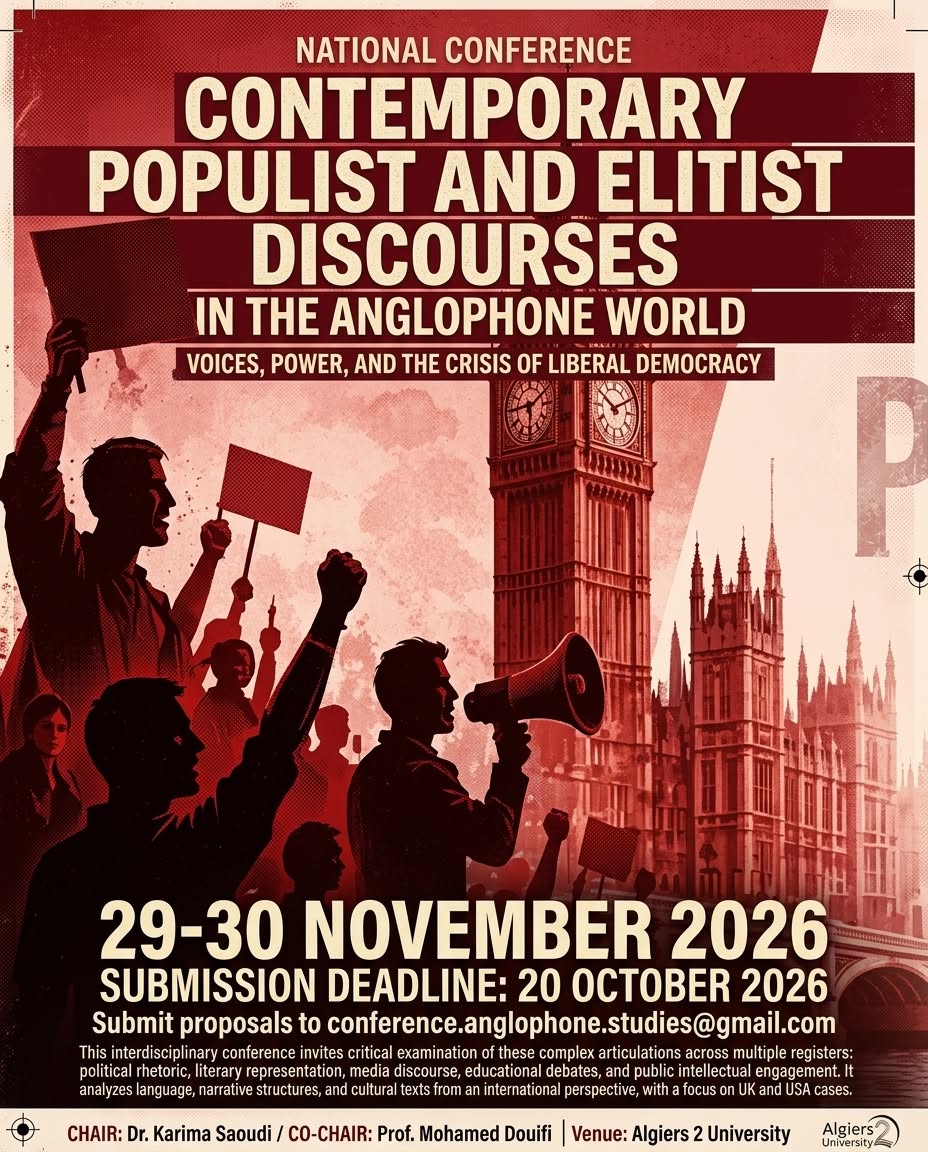
The University of Algiers 2 will host the National Conference on "Contemporary Populist and Elitist Discourses in the Anglophone World: Voices, Power, and the Crisis of Liberal Democracy" on 29–30 November 2026 in Algiers, Algeria. This interdisciplinary academic conference explores the complex relationship between populism, elitism, political rhetoric, and the challenges facing liberal democracy, with particular attention to contemporary developments in the United Kingdom and the United States. The conference aims to examine populism and elitism not only as political ideologies but also as rhetorical and discursive constructions that influence public opinion, social identities, political participation, and democratic debate. By bringing together perspectives from discourse analysis, political studies, literature, cultural studies, and media research, the event encourages a critical examination of how language, power, and representation shape contemporary political narratives across the Anglophone world. The scientific themes include the rhetoric of populism and elitism, classical and contemporary political theories, media and digital discourse, the public sphere, literary and cultural representations, identity politics, social movements, international relations, and geopolitics. Particular emphasis is placed on the linguistic and narrative strategies through which political actors construct identities, mobilize audiences, challenge established institutions, and negotiate relations of power. Chaired by Dr. Karima Saoudi, with Prof. Mohamed Douifi serving as Co-Chair, the conference invites interdisciplinary contributions addressing political rhetoric, literary representation, educational debates, media discourse, and public intellectual engagement. Researchers and academics working on Anglophone studies, linguistics, political communication, cultural analysis, and related disciplines are invited to submit proposals examining these questions from critical and international perspectives. The call for papers remains open until 20 October 2026, with notifications of acceptance scheduled for 31 October 2026. Submissions must include the participant's name and academic status, institutional affiliation, paper title, a 300-word abstract, five keywords, a brief bibliography, and contact information. Proposals should be submitted to the conference's official email address.